



Voices and Votes has been made possible in West Valley City by Utah Humanities.
Voices and Votes: Democracy in America is part of Museum on Main Street, a collaboration between the Smithsonian Institution and State Humanities Councils nationwide. It is based on an exhibition by the National Museum of American History. Support for Museum on Main Street has been provided by the United States Congress.
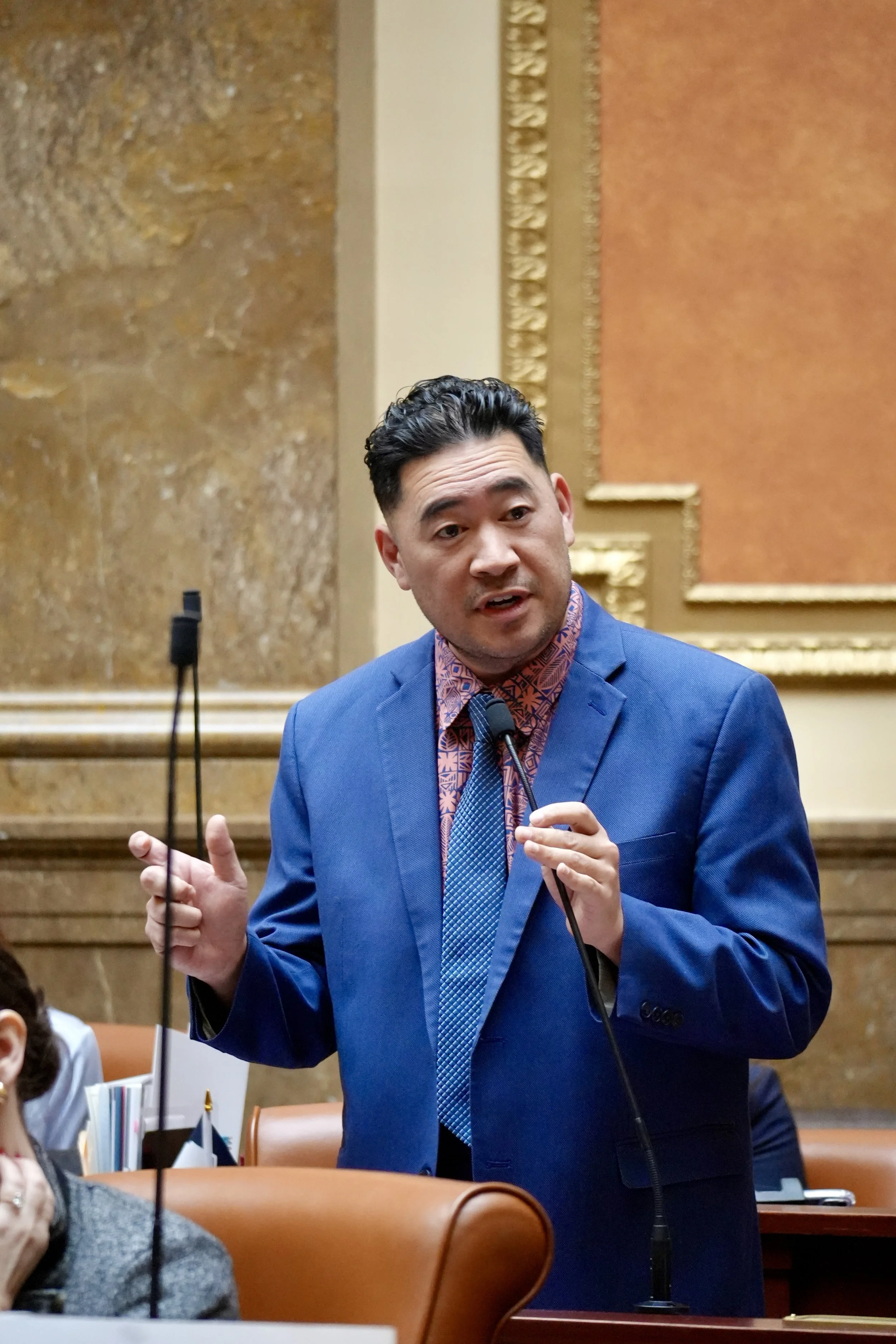
Jake Fitisemanu: It’s Our House | ARTrageous Online
Born in New Zealand, raised in Hawaiʻi, and now settled in West Valley City, Utah, Jake Fitisemanu is a Pacific Islander public health professional, community advocate, and proud American. One of the most defining moments of his childhood was the day his family dressed in their Sunday best and went to the courthouse to watch his father be sworn in as a United States citizen. Though life looked the same when they returned home, Jake would later understand the profound meaning of that moment.
This was the beginning of many exemplary lessons from Jake’s father about what it means to be an American. His father taught him that citizenship means having a voice—and a responsibility. It means helping shape the community where you live, not just residing in it. With the right to vote comes the power to participate, and he reminded Jake and his seven younger siblings often: “Your vote is your voice.”
Although Jake grew up understanding the importance of civic engagement, he didn’t know much about politics and had never met anyone who worked in government. His path into public service began locally, when he learned how city council worked and decided to get involved. He was elected twice to the West Valley City Council, where he focused on housing accessibility, neighborhood safety, and community well-being.
From there, he ran for the Utah House of Representatives. With hard work and strong support from his family and community, he became Representative Fitisemanu. “I’ve had to learn a lot,” he says. “I started off knowing almost nothing about how this works, and now I get to actively participate.”
Though he entered the legislature with humility, his grassroots initiatives have made a meaningful impact—expanding mental health resources, reducing barriers to workforce entry for skilled immigrants, and promoting sustainable infrastructure. He remains especially passionate about youth development and continues to encourage young people to share their ideas, reminding them that meaningful change begins when they choose to use their voice.
Part I | Path to Politics
Part II | Utah Politics: A History of Many Voices
Part III | It’s Our House
Topics: U.S. History, U.S. Government & Citizenship
Class: Social Studies
Grades: 9-12 | Time: 4 Hours
Platform: Online Learning Management System (LMS) with synchronous learning option (e.g., Zoom, Google Classroom) Or In-Classroom Learning
Tech Tools: Web Access
Quick Links

Introduction
Jake Fitisemanu is an American politician and public health administrator serving in the Utah House of Representatives for District 30 since January 2025. Actively rooted in the Samoan community and culture, he lives in West Valley City with his family and makes a point of walking his neighborhood each week—knocking on doors, listening, and connecting with those he represents. He prefers to call them neighbors rather than constituents, believing that personal relationships strengthen community representation.
In this three-part video series, Jake begins by sharing his personal path to politics and how he developed a deep commitment to civic engagement. He breaks down how everyday community concerns—like traffic safety—can be transformed into legislation through the democratic process. In the second video, Jake explores Utah’s rich political history and the contributions of Pacific Islanders in public service and highlights the story of a high school student whose advocacy for toy gun safety demonstrates how young people can shape real policy. In the final video, he uses the metaphor of a house to explain that democracy belongs to everyone, and that citizens are not “guests” but active decision-makers. Jake closes by encouraging youth to speak up, share their stories, and engage meaningfully with lawmakers to help build the future they envision.
What’s included in the course?
Module 1: Golden Apple in a silver Picture Frame
-
Golden Apple in a Silver Picture Frame: Exploring the Relationship between the Declaration of Independence and the Constitution, created by UVU Center for Constitutional Studies for America250 Utah.
-
Invite students to “dig deeper” by offering additional opportunities to research and reflect on democracy—its history, the struggles and achievements that shaped it, what it takes to sustain it, how connections are built, and why their voice and vote matter.
Try it Out!
Use the following prompts to initiate a class discussion about elections and the importance of voting.
How do you think people prepare before the vote in an election?
Why is voting important? In national elections? State elections? Local elections?
What kinds of things might you see on a ballot in a city election?
Possible Answers: Candidates for races (mayor, council, school board, etc.) Referendums, Propositions, Details about where you are voting (polling district)
Do you know anyone who has run for local office? Or that currently is in elected office?
Lesson Plans
Roadmap to Educating For American Democracy
Bill of Rights Institute- Each lesson and activity explores how the founding principles built into the Constitution allow the American people to protect and advance freedom and opportunity for all.
Video/Films
Amanda Gorman’s Inaugural Poem“The Hill We Climb” confronts a divided nation while affirming hope for renewal. It presents democracy as unfinished and fragile, shaped by both historical injustice and collective responsibility. The poem argues that democratic progress depends on citizens’ willingness to face truth, reject apathy, and keep climbing toward unity and justice.
Iron Jawed Angels (2004 Netflix series) A historical drama about women’s suffrage leaders fighting for women’s right to vote in the U.S., showing the long struggle behind democratic rights.
Joshua: Teenager vs. Superpower (2107 Documentary) Documents Hong Kong youth activist Joshua Wong and peers as they organize and protest for democratic rights and free elections, emphasizing youth power in political movements.
Websites
Smithsonian Voices & Votes: Democracy in America exhibit- Our democracy demands action, reaction, vision, and revision as we continue to question how to form “a more perfect union.” How do you participate as a citizen? From the revolution and suffrage, to civil rights and casting ballots, everyone in every community is part of this ever-evolving story – the story of democracy in America.