

Dallas Graham: Red Fred Stories, Life Lessons, and Discovering Utah’s Wild Side Through Science & Art | ARTrageous Online
Dallas Graham is a fiercely creative and compassionate graphic designer, writer, storyteller, and participatory artist based in Salt Lake City. Best known for the Red Fred Project, Dallas has made a lasting impact by helping children with rare and life-threatening illnesses become published authors—transforming their ideas, stories, and perspectives into powerful legacies through the art of bookmaking.
A passionate supporter of the arts with formal training in both visual art and writing, Dallas challenges the conventional ideas of success, asking, “Does a book only matter if it makes the New York Times Best Seller List?” His answer, shaped by a decade of working with young authors, is bold and affirming: “We are producing the greatest stories ever told.”
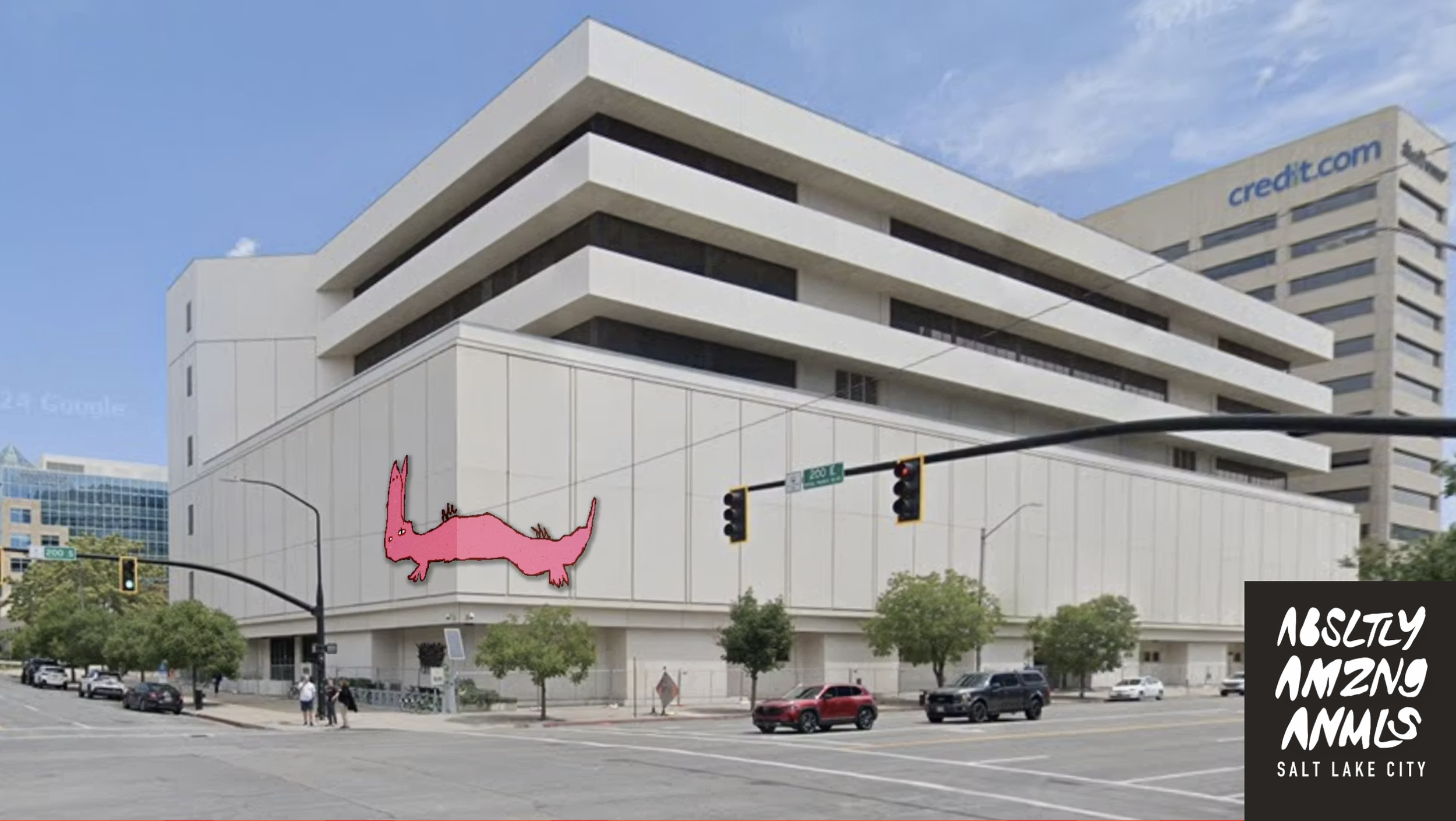
“What do you get when you cross a Rocky Mountain Elk with a Bushy-tailed Woodrat? I want to know and I want YOU to help me make it into art.” —Dallas Graham
After ten transformative years with Red Fred—working to publish 50 books in 50 states—Dallas launched a new, purpose-driven project in the spring of 2025: ABSLTLY AMZNG ANMLS. This playful and profound initiative turns Salt Lake City into a vibrant scavenger hunt reminiscent of Pokémon Go. Grounded in Dallas’s belief that medically fragile children are also artists, the project invites these young creators to imagine hybrid creatures by combining two Utah-native animals into a single, whimsical form.
From there, Dallas brings their visions to life as colorful, oversized wooden cutouts, which he installs on building corners, in alleyways, and across the cityscape. Passersby are encouraged to find these creatures, learn about Utah wildlife, and share selfies and messages with the child artists. For kids often confined to hospital rooms, receiving an outpouring of appreciation for their creativity becomes a deeply affirming and joyful experience. At its heart, ABSLTLY AMZNG ANMLS is about connection, creativity, and community development through public art.
This project inspired the arts integration lesson in this unit.
Topics: Writing, Reading & Writing, Social & Visual Art, Social and Emotional Learning, Civics, Ecology
Class: English, Social Studies, Science, Fine Arts, Library Media
Grades: 7-12 | Time: 4 Hours
Platform: Online Learning Management System (LMS) with in-classroom or synchronous learning option (e.g., Zoom, Google Classroom)
Tech Tools: QR Code Generator, GIMP
Quick Links
Watch Dallas Graham on YouTube
CURRICULUM MAP: Includes Core Standards and Learning Intentions
Part I: Meet Dallas Graham
Part II: Red Fred, A Blackbird Named Blue, and the Jolly Troop
Part III: No One Says It Like You Do
Inside the Unit
Video 1 introduces Dallas as he shares his unconventional artistic journey and creative inspirations.
Video 2 dives into the emotionally rich and fulfilling world of the Red Fred Project, highlighting how one life-changing experience with a child and their family shaped the course of his work.
Video 3 explores the question, “What is a book?”—as Dallas redefines our understanding of books, revealing that a story's worth and effort go far beyond a title or cover
Quotes to Use Throughout Curriculum:
“ YOU are the author of your life.” Brianna Heim
“You can still be brave when you are afraid.” Hallie Munro
“Birds are not meant to be caged.” Zuleyka Alvarado
“Heroes come in every shape, size, and color.” Colin Kopacko
What’s included in the course?
-
Essential Questions
How is seeking mentors throughout your life helpful?
How can being rebellious be good?
What is the value of giving balanced critique and feedback?
How can entrepreneurs help to build creativity in a community?
Learning Intentions – Upon completing this Module, students will:
Identify career-building strategies and define mentorship.
Explain journalistic goals and techniques for writing magazine artist reviews.
Express rebellion through action.
Describe the DIY movement and how it contributes to a creative community.
Apply writing techniques and literary devices to express an opinion on art.
Articulate and experience how entrepreneurs, creativity, and community intersect.
Success Criteria
I will pursue creative opportunities.
I will take opportunities to amplify others in my community doing good work to make where I live a better place.
Learning Outline
This 4-hour module is based on the video presentation by Angela Brown. It can be taught as a whole learning experience, or in chosen sections as time allows:
10 minutes: Video 1: Pre-Viewing Launch Activity– Seeking Out Mentors
20 minutes: Video 1: While Viewing– Meet Angela Brown: Salt Lake Underground Entrepreneur
10 minutes: Video 2: Post-Viewing– Career Path
5 minutes: Video 2: Pre-Viewing Launch Activity– Behind-the-Scenes of a Local Indie Mag
20 minutes: Video 2: While Viewing– Excerpts from the SLUG Writer’s Bible
10 minutes: Video 2: Post-Viewing– The Compliment Sandwich Writing Technique
15 minutes: Video 3: Pre-Viewing Launch Activity–Craft Lake City and the DIY Fest
20 minutes: Video 3: While Viewing– The DIY Reframing of Grandma’s Craft Culture
15 minutes: Video 3: Post-Viewing– Exploring Creative Outlets
60 minutes: Demonstration– Writing Artist Reviews for an Indie Mag
60+ minutes: Making Connections– Arts Integration Project - DIY Makers: That Thing You Are Making Is Awesome!
-
Supplies for Demonstration Activity
Animal Classification Video (6:52 min) An informative overview on animal classification and the distinctions between vertebrates, and invertebrates.
Tracks, Talons & Tails: Two Utah Animals, One Deep Dive Worksheet
Supplies for Art Integration Activity
Option 1: Low Tech Modality-
For drawing: Poster Board, Coloring pens.
For sculpting: Air-Dry Clay or Model Magic clay, acrylic paint, sharpies, paint markers
Option 2: High Tech Modality- GiMP or another image editing/ drawing software
Dallas Graham Inc. website
-
Launch Activity–Pre-Viewing: Video 1: Your Stories Matter
[15 min]
[Learning Intention 1]
Procedures:
Hook: Think, Pair, Share: Put students in pairs and ask them, “If you were to tell a story, what story would you tell? (10 min)
Take turns telling each other a story.
Why do you think these stories matter?
Have a class discussion about why our stories matter.
Ask Students: What does Dallas say in Video 1 about why stories matter? The way we see the world and how people decide to share what they've learned and know is so unique and so specific. Everyone has a story to share and each person and story tells us a little more about us and the world we live in.
While Viewing: Video 2: Red Fred, A Blackbird Named Blue, and the Jolly Troop
[25 min]
[Learning Intention 2]
Procedures:
Read the unit introduction to students.
Tell Students: We are going to watch the second video in this module. While watching, consider the value of sharing past experiences and life lessons with others.
Play Video 2: Red Fred, A Blackbird Named Blue, and the Jolly Troop (20:33 min)
Post-Viewing: Video 2: Sharing Life Lessons
[30 min]
[Learning Intention 2]
Procedures:
Tell Students: After each Red Fred Project author had finished writing their book, Dallas would say to each kid, “What do you want people to remember? You have two chances to tell the world two life lessons that you want them to remember, just from you.”
Ask Students: Do you remember any of those life lessons from those kids that Dallas shared in Video 2? Have students put the life lessons on the board or in the chat.
Add the following life lessons to the board. “Sometimes you just have to be brave.” “Heroes come in every shape, size and color.” “When you go on adventures with your friends, you become stronger.” “You can still be brave when you're afraid.” “Being in the dark doesn't mean you're alone.” “You're not alone; we stand together.” “Birds are not meant to be caged.” “Stand up for yourself.” “Good friends stick together.”
Tell Students: You are going to write your own two life lessons. What’s a life lesson you’ve learned from your experiences? Think back to significant moments, good or bad, in your life and determine what the takeaway was. Was it about patience, trusting your intuition, or finding strength in adversity? (Another option is to have students choose one of the life lessons the young authors generated and explain why they relate to it.)
In a round robin, have students share one of their two life lessons (or one they selected from the list above) and explain. Give students an example to get them started: A Life Lesson I Would Share: “Always trust your own pace.” In my own life, I’ve learned that not everyone’s journey is the same, and comparison can be a trap. I’ve spent too much time rushing to meet expectations, only to realize that the best outcomes come when I focus on my own path and timing. Trusting your process can bring peace and clarity.
Ask Students: What is the value of sharing past experiences and life lessons with others?
Pre-Viewing: Video 3: What Makes A Story Successful?
[10 min]
[Learning Intentions 1,3]
Procedures:
Ask Students:
What does a successful story mean to you personally? Is it about how many people read it? How it makes readers feel? How it makes you feel?
Think of a story that impacted you deeply. Was it a bestseller? Does that matter? Reflect on how that story made you feel and why it stuck with you.
What kind of success would you want from your writing? Money? Recognition? Helping others? Expressing yourself? Something else?
If you could write a book that changed one person’s life, would that be enough? Why or why not?
While Viewing: Video 3: No One Says It Like YOU Do
[10 min]
[Learning Intentions 1,3]
Procedures:
Tell Students: You are now going to watch the third video where Dallas talks about the process of making books with these children who are either hospitalized or are dealing with a rare disease or chronic illness.
Tell Students: As you listen to Dallas explain what goes into making a book, think about which role in the bookmaking process you’d be best at.
Play Video 3: No One Says It Like YOU Do (9:18 min)
Post-Viewing: Video 3: The Greatest Stories Ever Told
[15 min]
[Learning Intention 3]
Procedures:
Ask Students:
When talking about the Red Fred Project books written by the many children Dallas worked with, he said, “We are producing the greatest stories ever told.” Why do you think he believes that? Dallas reminds us that even if we think it has all been said or that we have nothing to offer, no two stories are the same and no one tells it quite like you do. Every child who authored a book with him had amazing stories inside of them and their words mattered.
Read this excerpt from Dallas: “In fact, in many ways, I think they are just as good or better, and the reason is because I look at the people I worked with, and I saw their lives. I saw what they were dealing with, I saw how they solved problems, I saw how they viewed the world, and it lit my life up in genuinely many awesome ways that I was thinking, these books are just as great as the books that the whole world is reading.”
Ask Students:
What did you learn about bookmaking in this last video? Was it surprising? It takes many people to write a book. The collaboration of ghost writers, editors, illustrators, design critiquers, and publishers. The author’s name is on the cover but a whole team is behind any book.
If you were collaborating on a book, what role do you think would be best at?
Based on Dallas’ premise that these medically-fragile kid authors redefine success, does anyone have anything to add to the following question: What makes a story or book or person) ‘successful?’ Discuss.
Demonstration: Tracks, Talons & Tails: Two Utah Animals, One Deep Dive
[75 min]
[Learning Intentions 4,5]
Procedures:
Ask Students: What are your favorite two animals in the world? Have students share with their elbow partners and explain why they like these animals and what they know about them. Have a few volunteers share with the class.
Tell Students: Your task is to choose two Utah animals that you want to know more about (e.g., American Pika + Desert Tarantula)—these can be mammals, reptiles, birds, amphibians, fish, or invertebrates. To help steer your research, we are first going to watch a short video on animal classification and the distinctions between vertebrates and invertebrates.
Have students watch Animal Classification Video (6:52 min)
Tell Students: Now it’s time to research Utah animals and choose two. Here are a few Utah wildlife websites to guide you:
https://fieldguide.wildlife.utah.gov/ This official database from the Utah Division of Wildlife Resources provides detailed information on all of Utah’s wildlife—mammals, birds, fish, reptiles, amphibians, and invertebrates. It's organized by common names, scientific names, and taxonomy for easy student exploration.
Wikipedia – “List of mammals of Utah”: A comprehensive list of mammal species found in Utah, including native and introduced species. You can explore details on each species—ranging from big game like moose and bighorn sheep to small critters like bats and prairie dogs—by clicking individual entries on the page. *Wikipedia also has a similar list of birds and arachnids
Tell Students: Now research the two animals you chose and fill out the Tracks, Talons & Tails: Two Utah Animals, One Deep Dive worksheet. For each animal, describe its key characteristics and behaviors. Be sure to include details about its habitat, diet, adaptations, ecosystem roles (producer, primary/secondary/tertiary consumer, decomposer) and any interesting or unique traits.
Tell Students: In the last two sections on the worksheet, compare your two animals by explaining how they are similar and different. Finally, add an image or sketch your two animals.
-
Making Connections: Arts Integration Project – Mash It Up And Write About it!
[75+]
[Learning Intentions 5,6,7,8]
Procedures:
Tell Students: You are going to combine traits of the two Utah animals you researched in the last section, then draw or sculpt it and write a backstory.
Read the last two paragraphs of the unit introduction (pasted below) to students and explain that the following excerpt describes Dallas’ initiative after the Red Fred project and inspired the art project we are about to do.
After ten transformative years with Red Fred—working to publish 50 books in 50 states—Dallas launched a purpose-driven project in the spring of 2025: ABSLTLY AMZNG ANMLS. This playful and profound initiative turns Salt Lake City into a vibrant scavenger hunt reminiscent of Pokémon Go. Grounded in Dallas’s belief that medically fragile children are also artists, the project invites these young creators to imagine hybrid creatures by combining two Utah-native animals into a single, whimsical form.
From there, Dallas brings their visions to life as colorful, oversized wooden cutouts, which he installs on building corners, in alleyways, and across the cityscape. Passersby are encouraged to find these creatures, learn about Utah wildlife, and share selfies and messages with the child artists. For kids often confined to hospital rooms, receiving an outpouring of appreciation for their creativity becomes a deeply affirming and joyful experience. At its heart, ABSLTLY AMZNG ANMLS is about connection, creativity, and community development through public art.
Show students Dallas’ website and scroll through to see Dallas’ mash-up animal characters. Have students try to guess what two animals he combined to make each of these silly, odd beasts. (Only Dallas knows the answer to this question!)
Explain to students that Dallas calls these combined animal characters a ‘portmanteau.’ A portmanteau is a French origin word blending the sounds and combining the meanings of two others, for example motel (from ‘motor’ and ‘hotel’) or brunch (from ‘breakfast’ and ‘lunch’). Invite students to come up with other examples of portmanteaus.
Design Mash-Up Animal:
Students are to create a new species by combining traits of both the Utah animals they researched in the ‘Demonstration’ section of this curriculum.
Name it, draw it, or sculpt it:
Low-Tech Option:
Have students draw their mash-up on a poster paper or poster board.
Have students sculpt their creature using air-dry clay, Model Magic or other, and then paint it.
High-Tech Option: Use GIMP or other image authoring software, have students digitally create their mash-up.
Determine its habitat, diet, adaptations, ecosystem roles (producer, primary/secondary/tertiary consumer, decomposer) and any interesting or unique traits.
Tell Students: Write a short narrative (½ to 1 page) starring your mash-up creature. Your story can be funny, adventurous, dramatic, or mysterious. It should include scientific elements from your animal research. Your story should include:
A clear description of your creature
Its unique adaptations and behavior
Its habitat and role in the ecosystem
A plot—something happens! (problem, adventure, encounter, etc.)
(Optional) Read the following prompt ideas to get students started:
“Deep in the red rock canyons, the elusive Tarantupika emerged at dawn…”
“When a drought hit the Wasatch Mountains, only one creature could survive both freezing nights and scorching days…”
“The Tarnoose, half moose, half tarantula, has a secret that might just save the salt flats of the west desert…”
“No one believed in the Snakelope until it showed up at the ranger station…”
Presentation: Have students share their whimsical creations.
Option 1:
Using QR Code Generator, have students add a QR code to their paper, sculptures, or digital mash-ups that contains their written story. (For paper poster drawings students can print the QR code on a sticker, label, or adhesive paper.)
Have students present their posters/models in a gallery walk. As students stroll, they can scan the QR codes and read the stories
Option 2:
Have students present their mash-ups to the class and read their stories out loud.
-
Invite students to “dig deeper” on these topics by providing additional options for research and reflection on bookmaking, storytelling, participatory art, and finding a story in everyone.
Dallas Graham’s 2025 Participatory Art Project: ABSLTLY AMZNG SLC!
Participatory Art
Participatory art is an approach to making art that engages public participation in the creative process, letting them become co-authors, editors, and observers of the work. This type of art is incomplete without the viewers' physical interaction.
Google ‘participatory art’ to see amazing examples created all over the world.
Writing Activities For Youth
Lessons for Emergent Writers- includes place-based, multimedia writing activities for youth of all ages.
Films
These films brought awareness and funding to help children and adults with rare diseases.
My Left Foot (1989) focused on a man with cerebral palsy. The movie won the Academy Award for Best Actor (Daniel Day-Lewis) and Best Actress in a Supporting Role. It was also nominated for 3 other Academy Awards.
Lorenzo’s Oil (1992) starring Susan Sarandon and Nick Nolte was nominated twice for Academy Awards and focused on the rare disease adrenoleukodystrophy (ALD).
Music By Prudence (2010) won the 2010 Academy Award for Best Documentary Short. The film features a woman living with arthrogryposis and her Afro-fusion band Liyana – all musicians living with disabilities.
Darius Goes West (2006) follows a boy living with Duchenne muscular dystrophy and his friends as they go on a road-trip across the country. As of June 2009, the film had won an unprecedented 28 film festival awards.
Websites
Red Fred Project- (Official Website) Children’s books authored by children living with rare diseases and life-threatening illnesses.
LibGuides- A curated list of free graphic design resources.
National Writing Project: The Write Time: Writing teachers from across the NWP Network interview young-adult and children’s authors about their books, their composing processes, and writers’ craft.
Cutthroat: A Journal of Arts: Includes online issues, writing contests, and more. They are dedicated to providing a safe space for a diversity of writers.
Articles
”Ashleigh Allen: Why I Write”: I began writing poetry as a child because I felt alive differently when I wrote. The page offered me a place to create on my own inventive terms, at my own pace, and under my own evolving directions. As a teen…